MATCHA Writer is a local-first desktop application. When used unlicensed (free edition) outside of a
course context, it does not share any information with us, MATCHA Technologies Ltd., or anyone else. This
is the starting point for privacy and security in MATCHA:
no shared information.
The rest of this page explains when and how MATCHA departs from this starting point. For more general
information about how we collect and use information throughout our business, including the portal tools
available to instructors and administrators, see our general
Privacy Policy.
Course participation and privacy levels
When a student is writing in MATCHA for a course activity, we need to keep track of some activity metadata
to enforce academic integrity constraints. However, MATCHA is able to operate with very little information
sharing. The level of information sharing can be controlled by setting the Privacy Level setting for a
course. The following privacy levels are available:
Level 1Standard
MATCHA Writer may share students'
personally identifiable information
as well as students'
work histories
with MATCHA and subprocessors (depending on the activity features used). See
Data Sharing by Activity Features
for more information. As described below, information shared is clearly stated to students as part
of a pre-activity information collection disclosure.
Level 2No personally identifiable information (PII) shared
MATCHA Writer encrypts all
personally identifiable information.
What is not shared with us:Personally identifiable information
is encrypted end-to-end between the student's copy of MATCHA Writer and the instructor's.
What is still shared with us: MATCHA Writer still shares
anonymous
control data
for troubleshooting and integrity enforcement purposes. It may also share anonymized student works
in readable form if the AI assistant is used or follow-up quizzes are used with AI assistance.
Incompatible features: Live Collaboration, Cloud Sync
Other limitations: A course passcode known only to course
staff needs to be used to access student submissions and activity control metadata. We cannot
recover lost passcodes or decrypt submissions. DOCX exports do not contain student identification
on the cover page.
Level 3No student personal information (PI) shared
A notch more private than Level 2, this mode prevents any student
personal information
from being shared.
What is not shared with us:Personal information
of any sort, including students' work products, is always encrypted end-to-end.
What is still shared with us:Control data.
Incompatible features: Like Level 2, plus: AI assistance,
student-specific questions for follow-up quizzes, AI assessment for follow-up quizzes, DOCX
submissions or exports.
Other limitations: Like Level 2.
Level 4Zero trust
The ultimate privacy-protecting mode, this mode is designed so you and your students don't have to
trust MATCHA services or your installed copy of MATCHA Writer with more information than is strictly
necessary for MATCHA to do its basic job.
What is protected: Everything in Level 3, plus students are
not allowed to browse web resources in the built-in browser (so there is no need to trust MATCHA
Writer with any confidential information students might use when browsing, such as login
credentials for your university's library). MATCHA Writer still asks students for name and ID to
attach this information to submissions, encrypted end-to-end, but pseudonyms or incomplete
information can be used if desired.
What is still shared:Control data.
Incompatible features: Like Level 3, plus normal browsing
(outside course packs) and follow-up quizzes.
Individual license use and technical support imply exceptions to these data-sharing rules, as described
below.
Licensing
When licensed by an individual, MATCHA Writer shares basic billing and account information with us and our
payment processor, Stripe, which handles sensitive payment information.
Note for teaching institutions: Students do not need to have individual licenses to use MATCHA for
their courses unless your institution has selected the
student pay licensing model.
Individual use of Cloud Sync and Live Collaboration
Cloud Sync and Live Collaboration are features that store a document's primary copy in MATCHA Cloud so it
can be synchronized across devices or shared with collaborators. When enabled, MATCHA may collect:
Document content, notes, references, project metadata, and edit history needed to synchronize the
project.
User, collaborator, permission, presence, and activity metadata needed to show and control shared
access.
Note for teaching institutions: These features can be and usually are disabled for course activities as
part of our global security controls, discussed above.
Technical support
Making a technical support request requires sharing personally identifiable information (minimally, name
and email). This allows us to get back to you about the problem. In addition, we suggest attaching your
project file if relevant. Project files contain your editing and browsing history for the project.
How we protect students' privacy
Information collection disclosures
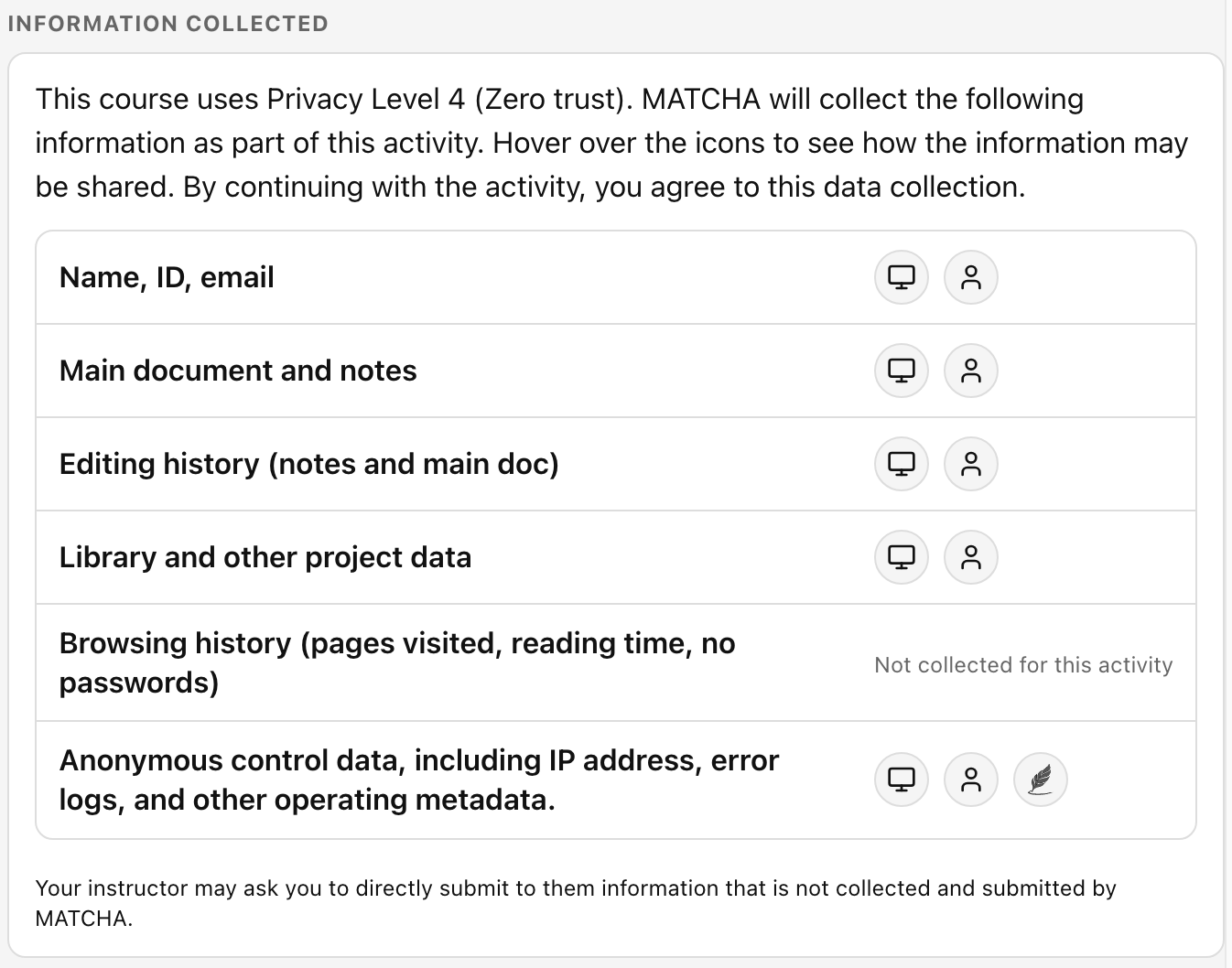
MATCHA clearly discloses the information it collects. Because collection depends on the features enabled
for an activity, MATCHA uses two layers of disclosure: a general disclosure in its End User License
Agreement and a specific activity disclosure shown before a student starts an instructor-led activity.
The activity-specific disclosure appears in the Activity Summary and emphasizes the information
collected for that activity's actual configuration.
Figure 1. Example Activity Summary information-collection disclosure detailing what information is
shared with whom (collected on the local computer only, shared with teaching staff, or shared with
MATCHA and/or subprocessors).
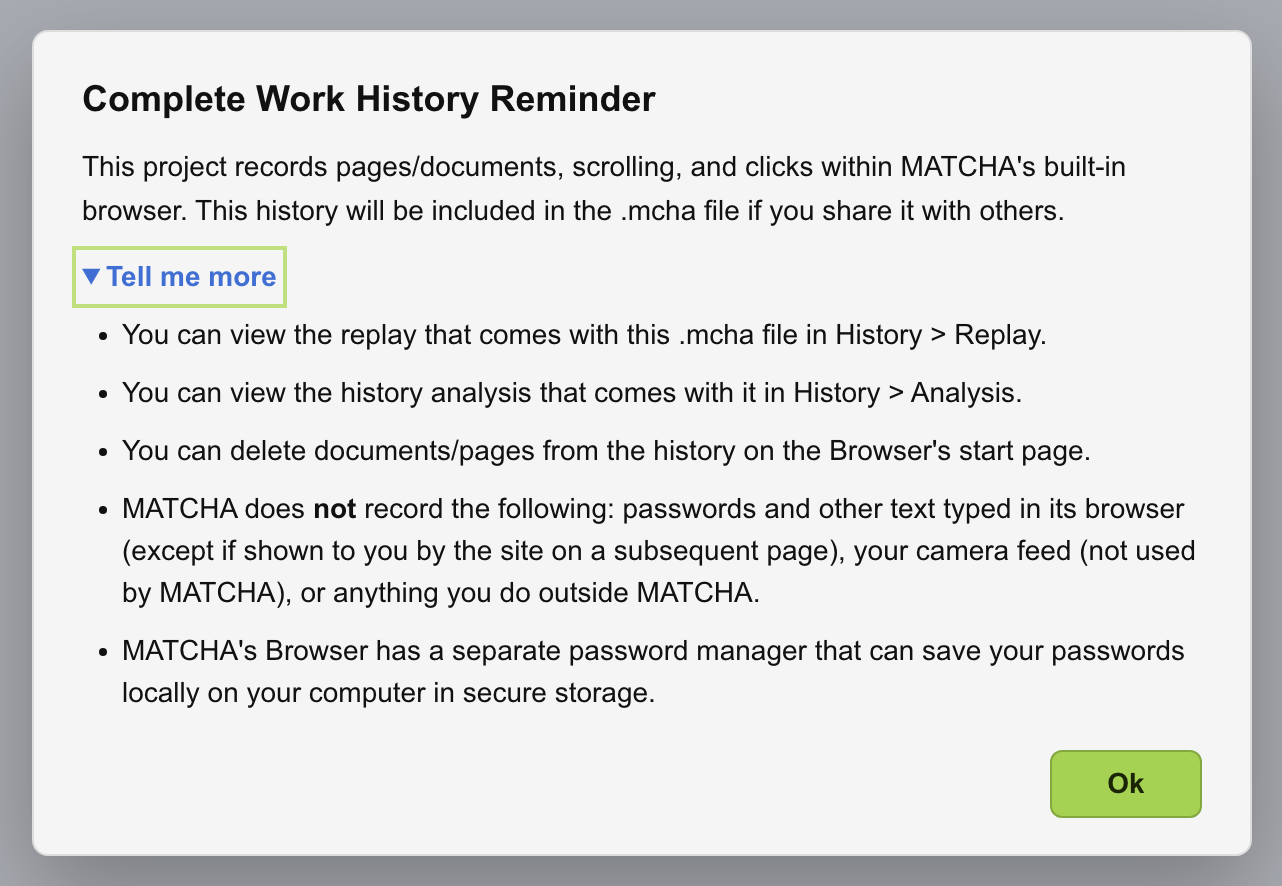
Just to be sure, we also show this reminder whenever a user starts a new browsing session and Complete
Work History (browsing recording) is enabled:
Figure 2. Reminder shown when Complete Work History is enabled (expanded view).
Security standards
Account security: MATCHA requires strong passwords, uses
best-practice password hashing techniques, locks accounts after repeated failed sign-in attempts, and
requires multi-factor authentication (OTP) for privileged accounts such as administrators and
instructors.
Encryption in transit: MATCHA services communicate over HTTPS or
WebSocket Secure, including service-to-service communications.
Encryption at rest: MATCHA-controlled cloud data is protected by
provider storage encryption and backup safeguards.
End-to-end encryption: When enabled (see above), end-to-end
encryption of personal student information guarantees that neither MATCHA nor its subprocessors can
access the information even as it transits through our services.
Cryptographic standards: MATCHA uses FIPS-aligned,
NIST-recommended cryptographic algorithms and modern key-management practices across its services.
Standards-compliant infrastructure: MATCHA's hosting facilities
are certified SOC 2 Type II and ISO/IEC 27001, 27701, 27017, and 27018.
Official Microsoft and Apple distribution channels: MATCHA Writer
is distributed as digitally signed installer packages verified malware-free and constrained to
low-security runtime profiles by Microsoft and Apple. Installation does not require administrator
privileges or granting any special permissions.
GDPR compliance
MATCHA is designed and operated to support GDPR-compliant deployments. In institution-configured courses
and activities, MATCHA commonly acts as a processor or service provider while the institution determines
the educational purpose, legal basis, notices, retention, and downstream use of records. For
MATCHA-controlled services such as the public website, account administration, billing, security
monitoring, and support, MATCHA may act as controller.
MATCHA supports privacy requests, deletion requests, access requests, and institution-directed request
handling subject to contractual, legal, security, backup, and institutional limits. Questions or privacy
requests may be sent to our Data Privacy Officer at
dpo@matchatech.io.
Additional data security options available to organizations
In addition to the four privacy levels described above, organizations can also configure the following
privacy and security settings.
Metadata residency
Accounts and organizations can be created within one of three geographically isolated MATCHA platforms.
Each platform uses separate data-bearing services and storage resources for accounts, organizations,
activities, submissions, and documents.
MATCHA USA: A FedRAMP-compliant US regional platform.
MATCHA Europe: An EU regional platform fully contained within the
EU (including backups).
MATCHA Global: The default global platform for organizations that
do not require a US or EU regional deployment. Data will often be placed within the user's
jurisdiction for performance optimization, but this is not guaranteed.
Submission residency
We offer additional residency options for student submissions (uploaded .docx or .mcha files) on our
optional MATCHA Cloud service.
Submissions for FedRAMP and EU-hosted organizations automatically locate within US and EU storage
buckets. Global-hosted organizations can choose any of the following locations:
Australia
Canada
European Union
Japan
Singapore
United Kingdom
US East, Central, or West
Data retention
Organizations can configure a course data retention period from 1 to 36 months. The default is 12
months. Courses, activities, submissions, and associated proctoring data are deleted after the course
end date plus the configured retention period.
Once data is deleted from active systems, deletion propagates to backup systems as backups rotate.
MATCHA's backup retention period is currently 180 days.
Questions?
If you have any questions about MATCHA and data privacy or security, please get in touch with our Data
Privacy Officer at dpo@matchatech.io.
We have a HECVAT package with additional documentation for institutional review. Contact dpo@matchatech.io
to obtain a copy.